The IDES Minor is anchored in the interdisciplinary strength of CCT, which has the largest concentration of design courses at Georgetown.
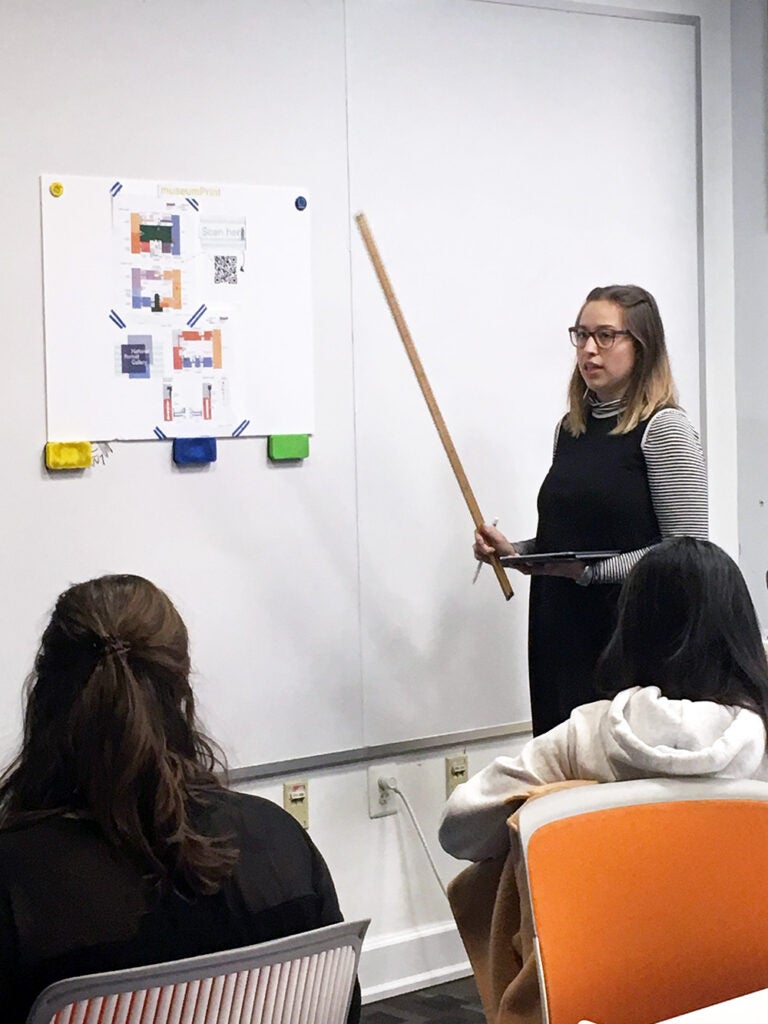
The minor also seeks to coalesce design-oriented electives from other campus departments and centers into a consistent and coherent path of study. IDES augments the coursework that students undertake in their majors by providing additional technical skills, workflows, and habits-of-mind that complement those learned in the Humanities, Arts, and Social or Natural Sciences.
Uniquely, it teaches students to relate design methods and thinking to their major area of study through project-based learning.
Expansion of Disciplinary Majors
While Design as a discipline traces its roots to the Servile Arts of ancient Greece, taking its place alongside the Liberal and Fine Arts, a more expansive notion of design as “the principal art and science of the technological age” (Nelson & Stolterman 2012) and “a new liberal art of technological culture” (Buchannan 1992) has emerged in the 21st Century. Design in the contemporary context encompasses not only material and technical skills, like sketching and machining, but also encompasses the “systems-oriented” worldview needed to address the complex problems faced by a globally connected and technologically mediated world. In this way, design is a transdisciplinary endeavor that cuts across and through traditional disciplines to provide interventions for public policy, business, social innovation, and education, to name only a few.
By integrating design practice as an expansion of disciplinary majors, the IDES Minor goes beyond multidisciplinary and interdisciplinary approaches. Integrated design inspires new perspectives that allow students to generate novel problem definitions, which rethink, reframe, and reshape traditional solutions born from disciplinary ways of thinking and doing.
Learning Goals
➢ Formative Goal
Students will locate themselves within design discourse, finding both a position in relation to different design philosophies and an orientation toward specific design styles and technological workflows. Students will learn where they “fit in” to the contemporary design landscape and which technical skills they have the most interest and aptitude for.
➢ Epistemology
Articulate how design produces knowledge and how this is the same and different from other disciplines in the physical sciences, arts, social sciences, or humanities.
➢ Process
Demonstrate functional understanding of iterative development as a generalizable approach to problem-solving in multiple contexts.
➢ Proficiency
Demonstrate skill in multiple design techniques and tools and an understanding of when and where each is appropriate.
➢ Execution
Plan and manage an individual project to completion, including embedded documentation, communication of aims and results, refinement of outcomes, and reflection on process.
➢ Enculturation
Properly give and receive constructive feedback/critique, understand differences and distinctions between design subdisciplines, and demonstrate the ability to collaborate in cross-functional teams.
Studio Learning
To accomplish the above learning goals, the IDES Minor relies on a studio-based pedagogy for its core course sequence as well as for many electives. Studio learning is immersive, hands-on, and collaborative by nature, making it an essential part of any design program. In a studio setting, students learn from peers as well as instructors. They experience what it means to be surrounded and embedded in a complex problem for extended periods of time. They are exposed to many conflicting perspectives that they are forced to navigate as they sift through information and evolve their own unique way of working in the world.