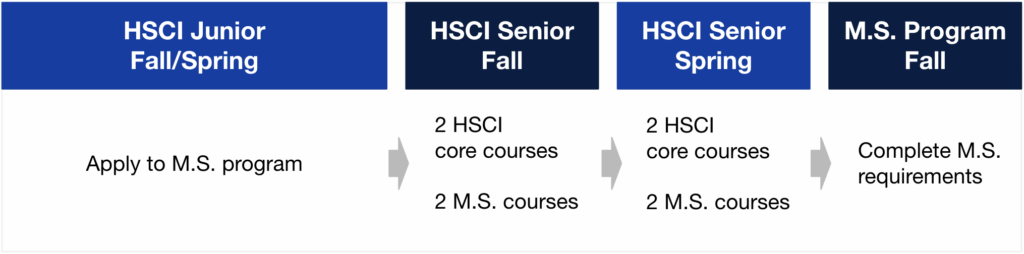
Highly motivated Georgetown BS in Human Science students can complete the requirements for the MS in Biotechnology in one semester after completing the bachelor’s program.
The Master of Science in Biotechnology program integrates science and biotechnology-based business, allowing flexibility for self-discovery and career orientation.
We focus on developing leadership skills, teamwork and entrepreneurship that are essential for career success. A highlight of the program is the capstone internship, which allows students to gain the desired work experience. Internship opportunities include research in industry, academic, and government laboratories and in business development, marketing, commercialization, finance, regulatory affairs, and technology transfer.
HSCI students with a minimum GPA of 3.5 in the major are eligible for the accelerated master’s program. Apply to this program by October 1 of your junior year. Students who wish to apply should inquire with Sumaira Akber, Assistant Dean, School of Health.
This is a comprehensive hands-on, laboratory-based course that introduces students to core techniques such as electrophoretic analysis of nucleic acids and proteins, polymerase chain reaction (PCR), Southern and Western blotting, ELISA, protein purification, tissue culture, DNA cloning, cell culture and Bioinformatics.
This course gives an introduction to problems and opportunities of start-up biotechnology companies and provides in-depth look at starting a biotechnology company to exit strategies for investors. Students will develop and report assigned case studies based on their ideas for start up biotechnology companies. Contributions will be made from senior venture capitalists, industrial scientists and business managers.
BIOT 6100: Biomedical Tissue Engineering & 3D Cell Culture in Drug Discovery 2 credits Instructor permission required
3-dimensional (3D) cell culture system is an important study model in drug discovery pipeline for its better mimicry of cellular microenvironment in vivo. This course will introduce students to essential cell culture concepts and techniques. In particular, it will focus on hands-on laboratory training of spheroid culture from tumor cells and organoid culture from primary cells. Different 3D culture techniques will be introduced including scaffold based and non-scaffold based. High throughput drug toxicity screening will be performed to examine effects in tumor proliferation, apoptosis, and invasion. Students will be exposed to the biomedical assays to screen for personalized medicine.
The Food Biotechnology course provides an introduction to the fascinating field of biotechnology and its role in the food industry. With broad-brush strokes, it covers many facets of the world of foods, which is very diverse yet very personal to all of us. The topics covered relate to food ingredients, fermentations, bioterrorism, FDA regulations, rapid detection techniques of food born pathogens, chemical senses, nutrigenomics and nutraceuticals. Laboratory component is provided as part of the course.
4 credits Prerequisite: BIOT 6590 Introduction to Biotechnology Internship
This is the capstone course in which students will be working to pursue defined objectives in companies in the biotechnology industry and agencies and institutions in the Washington, D.C., metropolitan area. Internships can be in basic research, business functions, industrial and biomedical sciences or intellectual property.
The sequencing of the human genome that was completed in 2001 and the explosion of ”omic data” has accelerated our understanding of basic genetics and how we think of biology. We are now in the “omic” era of molecular biology that has given birth to the new field of Bioinformatics. All this data can be used meaningfully for biological and clinical research only if we can extract the relevant functional information from them and convert biological data into knowledge of biological systems. Fortunately, by using bioinformatics we can make headway in understanding and extracting relevant biological information from these sequences. The aim of this course is to introduce the various tools and resources that are available as applicable to biomedical research. This course is highly experiential with both lectures and “hands-on” sessions.
Our students benefit from the services of the Biomedical Graduate Education career office, including one-on-one advising, skills workshops, leadership programs and more.