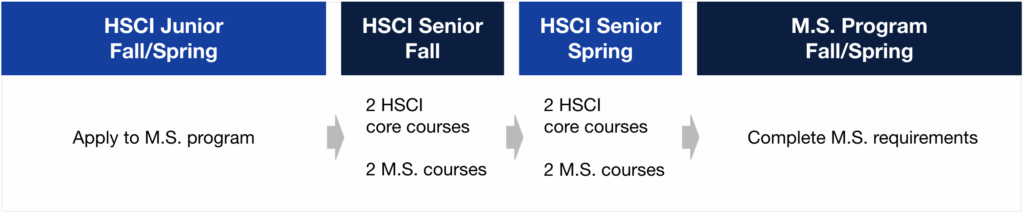
Highly motivated Georgetown B.S. in Human Science students can complete the requirements for the M.S. in Systems Medicine in two semesters after completing the bachelor’s program.
The Master of Science in System Medicine at Georgetown University is the first in the nation to train students in the new era of Big Data and -omics. Students get hands-on experience in state-of-the-art -omics technology, including next-generation sequence analysis, microarray sequence analysis, and mining clinical resources.
One of the highlights of our program is the capstone project/practicum/internship, which allows students to gain desired hands-on work experience. Georgetown University is located in Washington, D.C., giving students easy access to the world’s best institutions and hospitals, including the NIH, HHMI, FDA, Inova Fairfax, and MedStar Health. Students will have internship opportunities in renowned institutions, and each student will be matched with a mentor based on their career goals and interests.
HSCI students with a minimum GPA of 3.5 in the major are eligible to apply to this program by January 15 of their junior year. Students who wish to apply should inquire with Sumaira Akber, Assistant Dean, School of Health.
This course will cover major concepts, methods and tools of bioinformatics as applied to translational science and Cancer. The course will provide a strong foundation for students with any background in the computational analysis and interpretation of biological data. The course is designed as a combination of lectures and self-learning hands-on sessions. The hands-on session will cover the use of Next-generation sequencing data and other publicly available clinical data.
This course will introduce the idea of how to reason via statistical models to get and interpret information from big biological data. To introduce the idea of how formal models of data are used, examples will also be drawn from related sciences. Students will learn how to apply regression-type models to data and assess the consistency (or inconsistency) of the results they produce with theory. The course will encourage students to set biological or medical problems they are working on within the context of formal statistical models.
This course will cover the dynamic relationship between the microbiota and disease expression. It will consist of lectures, invited guest speakers, panels, and audiovisual material – all focusing on the epigenetic role of the microbiota in influencing the development of disease. Several clinical conditions, including inflammatory bowel disease (Crohn’s and ulcerative colitis), celiac disease, allergy and asthma, obesity, autoimmune diseases, neuropsychiatric conditions and cancer, will be examined through a microbial lens to learn more about the contribution of changes in the microbiota to disease states. A standard treatment will be compared to emerging microbial therapies. Students will learn about the role of next-generation microbial sequencing, including indications for, and how to interpret current testing modalities.
This course will cover the methodology and bioinformatics of next-generation sequencing technologies for virus detection and discovery in clinical, environmental, and biological samples. It will comprise a combination of lectures, invited seminars, and hands-on computer-based exercises utilizing web-based bioinformatics tools and publicly available databases for analyzing next-generation sequence datasets and for annotation of viral sequences. Additionally, the course will provide working-knowledge for developing bioinformatics pipelines for big data analysis. The course will include hands-on experience with the most popular Biomedical Workbench licensed software for data analysis. The course will also cover aspects of Translational Sciences applicable to analyze of ”Big data”. The course will be co-directed by an eminent scientist in the area of retroviruses from FDA.
This didactic course will provide an overview of the field of Biomedical Informatics from different perspectives. This course will provide an overview of biology and medicine relevant to healthcare from an informatics perspective. This course focuses on utilizing data to solve relevant health and informatics problems that the healthcare system is facing. Emphasis is given to understanding the basic building blocks, various information resources, and the application areas of Biomedical Informatics. Students will learn to explore the process of developing and applying computational techniques for determining the information needs of healthcare providers and patients. This class uses lectures, flipped classroom approaches where needed as well as student-led discussions. Relevant topics include Electronic Health Records, Patient Quality Assessment and Improvements, Evidence-Based Medicine, Natural Language Processing, Consumer and Public Health Informatics.
This is a new, interactive journal club formatted course guided by GUMC faculty, focusing on recent research published in any area of Systems Medicine. Students will take turns presenting selected papers, critically analyze them and lead discussions. Papers will be selected in consultation with GUMC faculty. The main goal of the course is to help students to think and analyze a research paper critically.
Biochemistry is fundamental to understanding the underlying cause of diseases and their treatments. This didactic course will be an intensive course, covering many aspects of biochemistry including biomolecules and metabolism. This course will be approached from a medical perspective. The course is designed as a combination of lectures and practical computer-based exercises utilizing functionalities of web-based resources. The students will experience the effect of mutations and polymorphisms on the genes that are causative of the underlying disease in each metabolic pathway. The lectures will be presented as a series of case studies. Most encountered clinical cases will form the core of the course. Aspects of Complementary and Integrative Medicine (CIM) approaches to health and disease states will be discussed. At the end of the course, students will be able to understand these diseases from a biochemical, informatics, and integrative medicine perspective.
This is the capstone course in which students will be working to pursue defined research objectives in systems medicine. The internship will be conducted at NIH, FDA, local companies in the Washington, DC area or Georgetown University. Internships can be in basic research, BIG data analysis or biomedical sciences.
This didactic course is designed to provide students an in-depth understanding of molecular phenotyping technologies for basic, clinical and translational research. The course will cover the basics of mass spectrometry-based metabolomics approach. We will discuss strategies for data generation as well as multivariate data mining tools and finally the clinical applications of this technology for studying disease onset and progression, drug metabolism and toxicity, discovery and validation of disease biomarkers and the effect of different treatments (drugs, radiation etc.) on the overall metabolism. The course will also include laboratory sessions that would provide practical insights into operations of a mass spectrometer and the use of interactive software for data analysis.
A hands-on introduction to methods and concepts used in technology companies to drive innovation and their application to systems medicine. This course will introduce students to key concepts in design thinking and lean startup as well as implications for healthcare and systems medicine. An ongoing project during the term will help students learn to apply these ideas and bring the concepts to life.
We will be using the Google design sprint methodology and its application to health situations. The course will be structured according to the phases of the design sprint (understand, define, sketch, sketch, decide, prototype, and validate). Learn more about the design print approach.
Advances in genomics have led to a major paradigm shift in medical practice. While medicine has always been “personal,” the availability of genomic data has made it possible to individualize care for many patients. This online course will provide an introduction to genomic medicine and will cover five main themes:
This is the capstone course in which students will be working to pursue defined research objectives in systems medicine. The internship will be conducted at NIH, FDA, local companies in the Washington, DC area or Georgetown University. Internships can be in basic research, BIG data analysis or biomedical sciences.
Learn More
The Georgetown Difference
Find out what sets our program apart in preparing students for impactful careers.
Our students benefit from the services of the Biomedical Graduate Education career office, including one-on-one advising, skills workshops, leadership programs and more.