Highly motivated Georgetown College of Arts & Sciences students can complete the requirements for the M.S. in Integrative Neuroscience in one semester after completing the bachelor’s program.
The M.S. in Integrative Neuroscience curriculum includes an extensive integrated overview of neuroscience, statistics, experimental design, and technical approaches.
Our graduates have a variety of career opportunities, including but not limited to the research industry, government agencies, education, and laboratories. We are dedicated to placing our students in their desired career field. Graduates can also continue their education with Ph.D. and M.D. programs.
The master’s program can be taken as an M.S. with Concentration in Biomedical Science Policy & Advocacy (BSPA), which serves as a valuable introduction to the world of science policy in Washington, D.C., and beyond. This mode of the master’s program provides students with essential training in the fundamentals of science policy and allows them to gain hands-on experience applying science policy in their specific field of study.
Application
Undergraduate students in the College of Arts & Sciences who meet the master’s program admission requirements are eligible to apply to this accelerated program by July 1 after their junior year. Students who wish to apply should inquire with their undergraduate advising dean and the director of the M.S. in Integrative Neuroscience program.
For more information about our program and admissions, please contact us.
Timeline
Undergraduates start taking master’s courses in their senior year, earning the master’s degree in the fall after completing the bachelor’s degree.
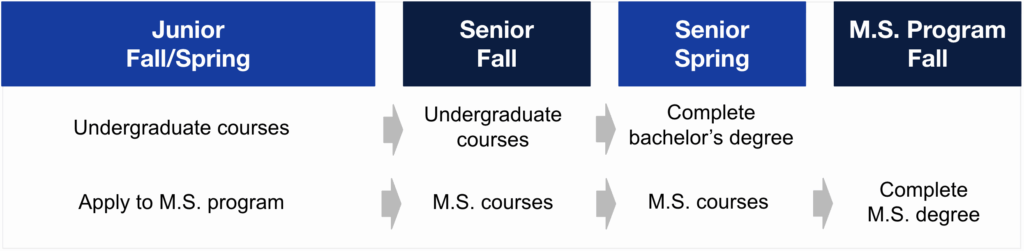
Note: Some programs will have different distributions of undergraduate and master’s courses to accommodate schedule conflicts.
Example Degree Plan
The degree plan below shows how you as an accelerated student can start taking graduate-level courses during your senior year in order to complete the 30-credit master’s program in the fall semester after your bachelor’s. Up to 50% of the graduate credits for the master’s degree may be taken during senior year. Alternatively, students may choose the M.S. with Concentration in Biomedical Science Policy & Advocacy, which has its own BSPA Concentration degree plan.
Senior – Fall
| Course Name | Graduate Credit(s) |
|---|---|
| Undergraduate courses | — |
| INNS 6500 Basic Neuroscience I | 4 |
| INNS 6000 Critical Readings in Neuroscience I | 1 |
| 5 Graduate Credits |
- Note: Full-time undergraduate status requires 12 credits.
- Students will need to complete RISE or a similar capstone research experience during their senior year to begin research that will culminate in the final master’s fall semester.
Senior – Spring
| Course Name | Graduate Credit(s) |
|---|---|
| Undergraduate courses | — |
| INNS 6501 Basic Neuroscience II | 4 |
| INNS 6201 Imaging in Neuroscience | 2 |
| NSCI 6007 Molecular Mechanisms of Neurodegeneration | 3 |
| INNS 6001 Critical Readings in Neuroscience I | 1 |
| 10 Graduate Credits |
Upon completion of the undergraduate degree requirements, you will receive your bachelor’s degree and may participate in Commencement with your undergraduate class. Contact your advising dean for more information.
Master’s – Fall
Complete the Biomedical Graduate Education Orientation at the start of the semester.
| Course Name | Graduate Credit(s) |
|---|---|
| INNS 6300 Translational Neuroscience | 2 |
| INNS 6400 Experimental Approaches & Techniques | 2 |
| INNS 9000 Research Practicum I | 4 |
| Graduate fall electives | 7 |
| 15 Graduate Credits |
- Students pay the per-semester flat rate.
- Students must complete a total of 30 graduate credits in order to graduate.
- Recommended electives include:
- BSPA 6603 Science and Technology in the Global Arena
- BSPA 6606 Public Policy for Scientists (Science Policy Concentration)
- NSCI 6006 Computational Neuroscience
- NSCI 6008 Topics in Neuroinflammation
- Follow the Biomedical Graduate Education Graduating Student Checklist to apply for graduation and to register for Commencement the following spring if you wish to attend.
Example Degree Plan: BSPA Concentration
The degree plan below shows how you as an accelerated student can start taking graduate-level courses during your senior year in order to complete the 30-credit M.S. with Concentration in Biomedical Science Policy & Advocacy in the fall semester after your bachelor’s. Up to 50% of the graduate credits for the master’s degree may be taken during senior year.
Senior – Fall
| Course Name | Graduate Credit(s) |
|---|---|
| Undergraduate courses | — |
| INNS 6500 Basic Neuroscience I | 4 |
| 4 Graduate Credits |
Note: Full-time undergraduate status requires 12 credits.
Senior – Spring
| Course Name | Graduate Credit(s) |
|---|---|
| Undergraduate courses | — |
| INNS 6501 Basic Neuroscience II | 4 |
| INNS 6201 Imaging in Neuroscience | 2 |
| NSCI 6007 Molecular Mechanisms of Neurodegeneration | 3 |
| BSPA 7005 Science Diplomacy and World Health | 2 |
| 11 Graduate Credits |
- Upon completion of the undergraduate degree requirements, you will receive your bachelor’s degree and may participate in Commencement with your undergraduate class. Contact your advising dean for more information.
Master’s – Fall
Complete the Biomedical Graduate Education Orientation at the start of the semester.
| Course Name | Graduate Credit(s) |
|---|---|
| INNS 6000 Critical Readings in Neuroscience I | 1 |
| INNS 6300 Translational Neuroscience | 2 |
| INNS 6400 Experimental Approaches & Techniques | 2 |
| BSPA 6603 Science & Technology in the Global Arena | 4 |
| BSPA 7906 Capstone Project | 3 |
| Graduate fall elective(s) | 3 |
| 15 fGraduate Credits |
- Students pay the per-semester flat rate.
- Students must complete a total of 30 graduate credits in order to graduate.
- Follow the Biomedical Graduate Education Graduating Student Checklist to apply for graduation and to register for Commencement the following spring if you wish to attend.
Master’s Courses
Visit M.S. in Integrative Neuroscience Courses to browse required and elective courses.
Learn More
Accelerated Programs FAQ
Answers to questions about the accelerated program.
Career Readiness
Our students benefit from the services of the Biomedical Graduate Education career office, including one-on-one advising, skills workshops, leadership programs and more.