Highly motivated Georgetown College of Arts & Sciences students can complete the requirements for the M.S. in Biohazardous Threat Agents & Emerging Infectious Diseases in one semester after completing their bachelor’s program.
The Master of Science in Biohazardous Threat Agents & Emerging Infectious Diseases program provides students with a solid foundation in the concepts of biological risk, disease threat, and mitigation strategies. The curriculum covers classic biological threats agents, global health security, emerging diseases, technologies, CBRN risk mitigation, and CBRN security. Graduates of our program are employed in both public health and security-focused positions across government and private sector organizations.
The master’s program can be taken as an M.S. with Concentration in Biomedical Science Policy & Advocacy (BSPA), which serves as a valuable introduction to the world of science policy in Washington, D.C., and beyond. This mode of the master’s program provides students with essential training in the fundamentals of science policy and allows them to gain hands-on experience applying science policy in their specific field of study.

Application
Undergraduate students in the College of Arts & Sciences who meet the master’s program admission requirements are eligible to apply to this accelerated program by July 1 after their junior year. Students who wish to apply should inquire with their undergraduate advising dean and the director of the M.S. in Biohazardous Threat Agents & Emerging Infectious Diseases program.
For more information about our program and admissions, please contact us.
Timeline
Undergraduates start taking master’s courses in their senior year, earning the master’s degree in the fall after completing their bachelor’s degree.
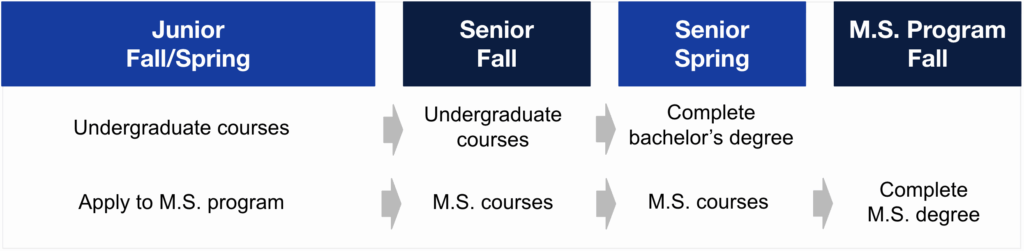
Note: Some programs will have different distributions of undergraduate and master’s courses to accommodate schedule conflicts.
Example Degree Plan
The degree plan below shows how you as an accelerated student can start taking graduate-level courses during your senior year in order to complete the 30-credit master’s program in the fall semester after your bachelor’s. Up to 50% of the graduate credits for the master’s degree may be taken during senior year.
Below is the degree plan for students to complete the standard Accelerated M.S. program. Alternatively, students may choose the M.S. with Concentration in Biomedical Science Policy & Advocacy, which has its own BSPA Concentration degree plan.
Senior – Fall
| Course Name | Graduate Credit(s) |
|---|---|
| Undergraduate courses | — |
| MICB 6515 Microbiology of Biological Threat Agents and Emerging Infectious Diseases | 3 |
| MICB 6551 Biohazardous Threat Agents & Emerging Infectious Diseases Seminar | 2 |
| MICB 6517 Bioterrorism or MICB 6525 Homeland Security | 3 |
| 8 Graduate Credits |
Senior – Spring
| Course Name | Graduate Credit(s) |
|---|---|
| Undergraduate courses | — |
| MICB 6520 Agroterrorism | 3 |
| MICB 6577 Defense Threat Reduction Initiatives | 2 |
| Recommended: Graduate Spring Elective(s) | 2 |
| 7 Graduate Credits |
- Note: Full-time undergraduate status requires a minimum of 12 total credits. Graduate credits count toward this total.
- Upon completion of the undergraduate degree requirements, you will receive your bachelor’s degree and may participate in Commencement with your undergraduate class. Contact your advising dean for more information.
Master’s – Fall
Complete the Biomedical Graduate Education Orientation at the start of the semester.
| Course Name | Graduate Credit(s) |
|---|---|
| MICB 6517 Bioterrorism or MICB 6525 Homeland Security | 3 |
| Graduate Fall Electives | 12 |
| 15 Graduate Credits |
- Students pay the per-semester flat rate.
- Students must complete a total of 30 graduate credits in order to graduate.
- Students may take internships as electives:
- BHTA 7950 Internship Experience (must be with an organization outside the university)
- MICB 6220 Advanced Techniques in Microbiology I (lab rotation in the Department of Microbiology & Immunology)
- Follow the Biomedical Graduate Education Graduating Student Checklist to apply for graduation and to register for Commencement the following spring if you wish to attend.
Example Degree Plan: BSPA Concentration
Below is an example degree plan for accelerated students to complete the M.S. with Concentration in Biomedical Science Policy & Advocacy by taking three specific graduate electives. Up to 50% of the graduate credits for the master’s degree may be taken during senior year.
Senior – Fall
| Course Name | Graduate Credit(s) |
|---|---|
| Undergraduate courses | — |
| MICB 6515 Microbiology of Biological Threat Agents and Emerging Infectious Diseases | 3 |
| MICB 6551 Biohazardous Threat Agents & Emerging Infectious Diseases Seminar | 2 |
| MICB 6517 Bioterrorism or MICB 6525 Homeland Security | 3 |
| 8 Graduate Credits |
Senior – Spring
| Course Name | Graduate Credit(s) |
|---|---|
| Undergraduate courses | — |
| MICB 6520 Agroterrorism | 3 |
| MICB 6577 Defense Threat Reduction Initiatives | 2 |
| BSPA 7005 Science Diplomacy and World Health | 2 |
| 7 Graduate Credits |
- Note: Full-time undergraduate status requires a minimum of 12 total credits. Graduate credits count toward this total.
- Upon completion of the undergraduate degree requirements, you will receive your bachelor’s degree and may participate in Commencement with your undergraduate class. Contact your advising dean for more information.
Master’s – Fall
Complete the Biomedical Graduate Education Orientation at the start of the semester.
| Course Name | Graduate Credit(s) |
|---|---|
| MICB 6517 Bioterrorism or MICB 6525 Homeland Security | 3 |
| Graduate Fall Electives | 5 |
| BHTA 6603 Science & Technology in the Global Arena | 4 |
| BSPA 7906 Capstone Project | 3 |
| 15 Graduate Credits |
- Students pay the per-semester flat rate.
- Students must complete a total of 30 graduate credits in order to graduate.
- Students may take internships as electives:
- BHTA 7950 Internship Experience (must be with an organization outside the university)
- MICB 6220 Advanced Techniques in Microbiology I (lab rotation in the Department of Microbiology & Immunology)
- Follow the Biomedical Graduate Education Graduating Student Checklist to apply for graduation and to register for Commencement the following spring if you wish to attend.
Master’s Courses
Visit M.S. in Biohazardous Threat Agents & Emerging Infectious Diseases Courses to browse our required and elective courses.
Learn More
Accelerated Programs FAQ
Answers to questions about the accelerated program.
Program Highlights
Find out what sets our program apart in preparing students for impactful careers.
Career Readiness
Our students benefit from the services of the Biomedical Graduate Education career office, including one-on-one advising, skills workshops, leadership programs and more.