
Highly motivated Georgetown College of Arts & Sciences students can begin completing the requirements for the M.S. in Systems Medicine during the bachelor’s program.
Advances in molecular biology, genomics, and human genome sequencing are transforming how we understand health and disease. Rather than viewing disease as damage to a single gene, organ, or isolated body part, Systems Medicine studies disease as an interconnected system of genes, proteins, cells, tissues, and organs. Disease rarely results from one broken gene; instead, it often emerges from disruptions that spread across networks of connected biological components, forming what researchers call a disease module.
The Master of Science in Systems Medicine at Georgetown University is the first in the nation to train students to integrate data from genomics, transcriptomics, proteomics, metabolomics, and other disciplines with computational and network-based approaches to map these disruptions and uncover the mechanisms that drive disease. By understanding how and why a biological system becomes disrupted, we can move beyond simply treating symptoms toward identifying underlying disease mechanisms, discovering new diagnostic markers and drug targets, predicting individual risk and treatment response, and ultimately developing more precise and personalized approaches to patient care.
One of the highlights of our program is the capstone project/practicum/internship, which allows students to gain desired hands-on work experience. Georgetown University is located in Washington, D.C., giving students easy access to the world’s best institutions and hospitals, including the NIH, HHMI, FDA, Inova Fairfax, and MedStar Health. Students will have internship opportunities in renowned institutions, and each student will be matched with a mentor based on their career goals and interests.
This program may be taken as an M.S. with Concentration in Applied AI in Systems Medicine, which prepares students to enhance and expand the impact of systems medicine using artificial intelligence (AI) tools.
Application
Undergraduate students in the College of Arts & Sciences who meet the master’s program admission requirements are eligible to apply to this accelerated program by July 1 after their junior year. Students who wish to apply should inquire with their undergraduate advising dean and the director of the M.S. in Systems Medicine program.
For more information about our program and admissions, please contact us.
Timeline
Undergraduates start taking master’s courses in their senior year, earning the master’s degree in the spring after completing their bachelor’s degree.
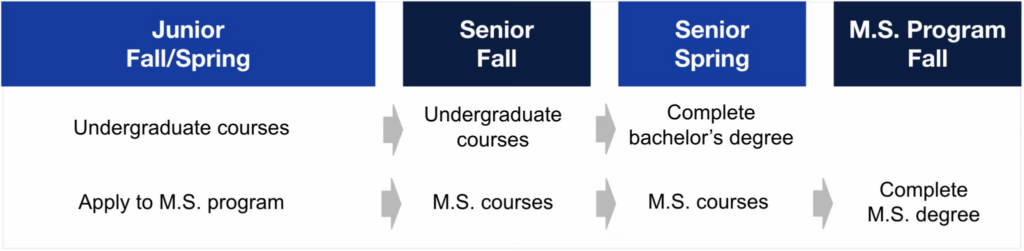
Note: Some programs will have different distributions of undergraduate and master’s courses to accommodate schedule conflicts.
Example Degree Plan
The degree plan below shows how you as an accelerated student can start taking graduate-level courses during your senior year in order to complete the 32-credit master’s program in the fall semester after your bachelor’s. Up to 50% of the graduate credits for the master’s degree may be taken during senior year. Alternatively, students may choose the M.S. with Concentration in Applied AI in Systems Medicine, which has its own concentration degree plan.
Senior – Fall
| Course Name | Graduate Credit(s) |
|---|---|
| Undergraduate courses | — |
| SYSM 5720 Physiological Genomics | 5 |
| SYSM 5900 Applications of Biostatistics to Big Data | 3 |
| SYSM 5960 Clinical Metabolomics | 2 |
| 10 Graduate Credits |
Senior – Spring
| Course Name | Graduate Credit(s) |
|---|---|
| Undergraduate courses | — |
| SYSM 5940 Translational Bioinformatics | 3 |
| SYSM 5850 An Introduction to Genomic Medicine | 3 |
| 6 Graduate Credits |
- Note: Full-time undergraduate status requires a minimum of 12 total credits. Graduate credits count toward this total.
- Upon completion of the undergraduate degree requirements, you will receive your bachelor’s degree and may participate in Commencement with your undergraduate class. Contact your advising dean for more information.
Master’s – Fall
Complete the Biomedical Graduate Education Orientation at the start of the semester.
| Course Name | Graduate Credit(s) |
|---|---|
| SYSM 7950 Systems Medicine Capstone | 4 |
| SYSM 5910 Biomedical Informatics | 3 |
| Graduate Electives | 9 |
| 16 Graduate Credits |
- Students pay the per-semester flat rate.
- Students must complete a total of 32 graduate credits in order to graduate.
- Follow the Biomedical Graduate Education Graduating Student Checklist to apply for graduation and to register for Commencement the following spring if you wish to attend.
Example Degree Plan: Applied AI in Systems Medicine Concentration
The degree plan below shows how you as an accelerated student can start taking graduate-level courses during your senior year in order to complete the 32-credit M.S. with Concentration in Applied AI in Systems Medicine in the fall semester after your bachelor’s by taking three specific graduate electives. Up to 50% of the graduate credits for the master’s degree may be taken during senior year.
Senior – Fall
| Course Name | Graduate Credit(s) |
|---|---|
| Undergraduate courses | — |
| SYSM 5780 AI Fundamentals and Ethics | 3 |
| 3 Graduate Credits |
Senior – Spring
| Course Name | Graduate Credit(s) |
|---|---|
| Undergraduate Courses | — |
| SYSM 5410 AI Applications in Structural Biology | 3 |
| SYSM 5800 AI Applications in Systems Medicine | 3 |
| SYSM 5850 An Introduction to Genomic Medicine | 3 |
| SYSM 5940 Translational Bioinformatics | 3 |
| 12 Graduate Credits |
- Upon completion of the undergraduate degree requirements, you will receive your bachelor’s degree and may participate in Commencement with your undergraduate class. Contact your advising dean for more information.
Master’s – Fall
Complete the Biomedical Graduate Education Orientation at the start of the semester.
| Course Name | Graduate Credit(s) |
|---|---|
| SYSM 5720 Physiological Genomics | 5 |
| SYSM 5900 Applications of Biostatistics to “BIG DATA” | 3 |
| SYSM 5910 Biomedical Informatics | 3 |
| SYSM 5960 Clinical Metabolomics | 2 |
| SYSM 7950 Systems Medicine Capstone | 4 |
| 17 Graduate Credits |
- Students pay the per-semester flat rate.
- Students must complete a total of 32 graduate credits in order to graduate.
- Follow the Biomedical Graduate Education Graduating Student Checklist to apply for graduation and to register for Commencement the following spring if you wish to attend.
Master’s Courses
Visit M.S. in Systems Medicine Courses to browse our required and elective courses.
Learn More
Accelerated Programs FAQ
Answers to questions about the accelerated program.
About Systems Medicine
Find out what sets our program apart in preparing students for impactful careers.
Career Readiness
Our students benefit from the services of the Biomedical Graduate Education career office, including one-on-one advising, skills workshops, leadership programs and more.