
Highly motivated Georgetown College of Arts & Sciences students can complete the requirements for the M.S. in Tumor Biology in one semester after completing the bachelor’s program.
Students in the Master of Science in Tumor Biology program will learn basic concepts in cancer biology. Topics include biochemistry, pharmacology, prevention and methodology specific to cancer research. Students will be trained in basic laboratory techniques and will complete a research project. Graduates from our program will have a comprehensive understanding of the underlying mechanisms of cancer progression and the existing clinical challenges in treating this disease.
Students are required to complete a Laboratory Research Project (TBIO 7050 and 7060). Students are matched with a cancer researcher at Lombardi Comprehensive Cancer Center based on mutual preferences. In the laboratory, students receive hands-on training for planning and conducting experiments to answer key questions in cancer biology. Common techniques learned include methods in cell culture, molecular biology (analysis of DNA, RNA, proteins or metabolites) or in vivo models of cancer.
Application
Undergraduate students in the College of Arts & Sciences who meet the master’s program admission requirements are eligible to apply to this accelerated program by July 1 after their junior year. Students who wish to apply should inquire with their undergraduate advising dean and the director of the M.S. in Tumor Biology program.
For more information about our program and admissions, please contact us.
Timeline
Undergraduates start taking master’s courses in their senior year, earning the master’s degree in the fall after completing their bachelor’s degree.
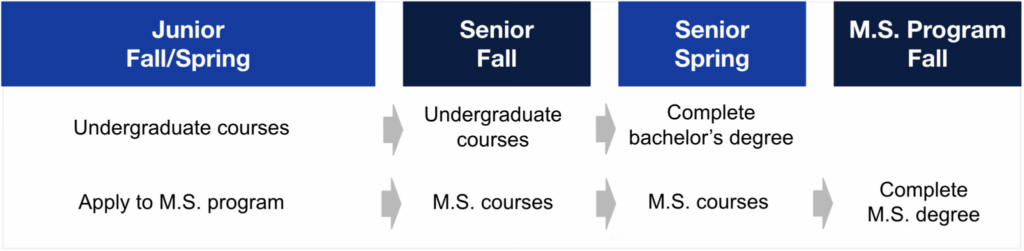
Note: Some programs will have different distributions of undergraduate and master’s courses to accommodate schedule conflicts.
Example Degree Plan
The degree plan below shows how you as an accelerated student can start taking graduate-level courses during your senior year in order to complete the 30-credit master’s program in the fall semester after your bachelor’s. Up to 50% of the graduate credits for the master’s degree may be taken during senior year.
Senior – Fall
| Course Name | Graduate Credit(s) |
|---|---|
| Undergraduate courses | — |
| TBIO 6508 Cellular & Molecular Aspects of the Transformed Cell | 4 |
| TBIO 6510 Biochemistry for Cancer Research | 4 |
| 8 Graduate Credits |
Senior – Spring
| Course Name | Graduate Credit(s) |
|---|---|
| Undergraduate courses | — |
| TBIO 6536 Cancer Pharmacology | 4 |
| TBIO 7060 Cancer Research Techniques | 3 |
| 7 Graduate Credits |
- Note: Full-time undergraduate status requires a minimum of 12 total credits. Graduate credits count toward this total.
- Upon completion of the undergraduate degree requirements, you will receive your bachelor’s degree and may participate in Commencement with your undergraduate class. Contact your advising dean for more information.
Master’s – Fall
Complete the Biomedical Graduate Education Orientation at the start of the semester.
| Course Name | Graduate Credit(s) |
|---|---|
| TBIO 7050 Cancer Research Techniques | 3 |
| Graduate electives | 12 |
| 15 Graduate Credits |
- Students pay the per-semester flat rate.
- Students must complete a total of 30 graduate credits in order to graduate.
- Follow the Biomedical Graduate Education Graduating Student Checklist to apply for graduation and to register for Commencement the following spring if you wish to attend.
Master’s Courses
Visit M.S. in Tumor Biology Courses to browse our required and elective courses.
Learn More
Accelerated Programs FAQ
Answers to questions about the accelerated program.
Program Highlights
Find out what sets our program apart in preparing students for impactful careers.
Student Resources
Explore resources available to our students, from academic support to community spaces and groups.
Career Readiness
Our students benefit from the services of the Biomedical Graduate Education career office, including one-on-one advising, skills workshops, leadership programs and more.